Ish's One-Handed Sledgehammer
Earth AbidesIsh's One-Handed Sledgehammer accompanies Ish from his cabin into his journey through a world emptied of its former order. It serves as a usable tool, but also as a tangible connection to the past: when fever makes Ish contemplate what he may leave behind, the hammer occupies his attention as an object with a specific history and condition. Its repeated presence links private memory to immediate survival.
Identity and Material Details
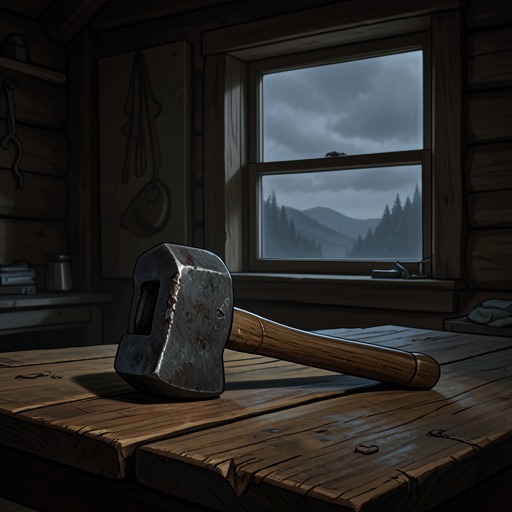
The hammer is a single-jack, a one-handed tool associated with the work of miners. Ish inventories it in precise physical terms: its head weighs four pounds, its handle is a foot long and slightly cracked, and the head is weathered and somewhat rusty, though still serviceable. The details place wear and usefulness side by side. It is not pristine equipment preserved from the old world; it has endured exposure and damage, yet remains capable of work.
Its history gives the object a human past beyond Ish. He understands it as having been used by a miner in a low tunnel, where a worker swung a hammer in one hand to drive rock drills. The four-pound head, Ish observes, was a weight a person could manage in that way. This remembered labor makes the hammer more than an anonymous piece of scrap: its form carries evidence of a vanished kind of work and of the people who once performed it.
The Cabin and the Object's New Visibility
After reaching his cabin, Ish drops the hammer as he opens the door. It lands on its heavy head, rocks briefly, and comes to rest with the handle pointing upward. That precarious balance turns an ordinary tool into a fixed presence in the room. When Ish later lies in his bunk, feverish and expecting that he may die, the upright hammer holds an unusually large place in his thoughts. He mentally records its name, weight, dimensions, damage, and remaining usefulness as though making an inventory of possessions to leave behind.
The moment changes the hammer's status without changing its physical condition. In ordinary use it can recede into the background as a tool; under the pressure of Ish's illness, he studies it as a particular object, marked by its flaws and its past. His recollection that he had been pleased to find it emphasizes the value he places on its connection to the old world. Its continued serviceability matters, but so does the history that makes it recognizable as more than an implement for the present emergency.
Crisis and Flight
When Ish sees crisis headlines in a newspaper through a locked pool-room window, he returns to his car and takes up the hammer, raising its heavy head toward the door. His first response is checked by habits of law-abiding life: he hesitates at the thought of breaking into a store and looks for signs of authority. Panic eventually overcomes that restraint. The episode places the hammer at the boundary between the rules Ish has inherited and the urgent choices demanded by a world in which those rules may no longer be enforced; the evidence here records his movement toward the door, not the outcome of an attempt to break it open.
Later, preparing to leave, Ish selects a station wagon from among the cars parked in the streets. As he is about to drive away, he realizes that something is missing. He returns to his old car, retrieves the hammer, and lays it at his feet in the station wagon. The action is small but decisive: he does not treat the hammer as a possession that can be casually abandoned when he changes vehicles. It is included in the equipment he carries into the uncertain journey, even as he gathers food and other supplies.
Practical Use and Significance
At Kingman, where electric power has failed but water still runs, Ish uses the hammer with a cold chisel to plug a hole in a truck's gasoline tank. He catches the escaping fuel in a five-gallon can and transfers it to his vehicle. The scene confirms the quality Ish had mentally noted while sick: despite its cracked handle and weathered head, the hammer remains serviceable. Its remembered past does not make it merely commemorative; it can still help solve a concrete problem of travel and survival.
Across these appearances, the hammer moves between remembrance and action. It recalls human labor from the vanished world, becomes an object of anxious attention in the cabin, and is carried forward as equipment in Ish's flight. Its significance rests in that conjunction: the past is not preserved intact, but a worn tool from it can still be handled, remembered, and put to work.